
Operations Workflow Boundaries
This article explains what the Operations Help category covers and where its boundaries are, so operators do not mistake a review surface for a resolution or accounting system.
Who this is for: Owners or staff who need clear boundaries before using Queue or Issues.
What this category covers
Section titled “What this category covers”- Queue as an operational review surface that lists records needing attention and links out to owning modules.
- Issues as an operational review surface for blockers and exceptions, including the empty state when none exist.
- Observed Queue tabs, counts, columns, and safe open-into-module review.
What this category excludes
Section titled “What this category excludes”- Issue Review detail workflows — deferred until a product-supported synthetic Issue record exists. No
/operations/issue-reviewroute is published in this batch. - Team and Settings (Configuration) — documented separately later.
- Mutation-heavy actions such as resolving, closing, assigning, or deleting an Issue, or changing a Queue item’s status — these require a separate, explicitly approved verification pass on synthetic or fixture records.
- Autonomous workflow execution, AI dispatch, automatic issue resolution, SLA enforcement, technician routing, GPS tracking, and alerting or escalation rules.
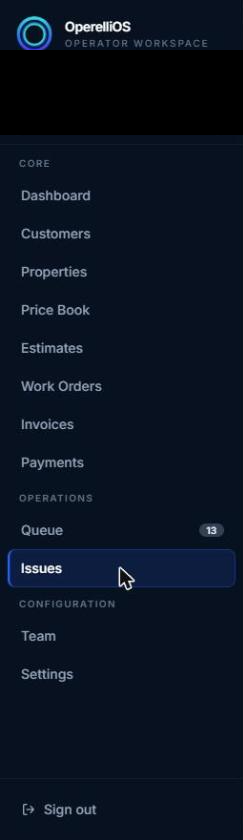
The two surfaces covered by this category: Queue and Issues.
Important distinctions
Section titled “Important distinctions”- Queue and Issues are operational review surfaces. Visible actions in this Help category are documented only when executed or safely observed.
- Operations does not replace the deterministic workflow, financial, policy, audit, or outbox/delivery rules that live in owning modules such as Invoices, Payments, Estimates, and Work Orders.
- A record shown in Queue or referenced from Issues is a pointer to that owning module’s record, not a separate copy of its financial or workflow state.
- AI may assist with summaries or recommendations only when a verified AI surface exists. AI does not own issue resolution, dispatch, payment state, workflow state, permissions, or financial truth.